 |
| #LEARNUARY part 3 |
Showing posts with label negative space. Show all posts
Showing posts with label negative space. Show all posts
Saturday, 2 February 2019

Friday, 9 November 2018
Anatomy of a Shot: 'Spirited Away'; Staging of the balcony meal and use of 'Ma!'
A big part of my teaching work is trying to get students to break down the animation, composition and timing of well known, and not so well known, performance animation from around the world. Whether it is a short cartoon, in-game or a feature film, you can learn so much from studying the work of others.
This post breaks down a shot to show the rhythm created by combining thoughtful staging, production design, strong key-frames and character performance. It uses the environment as a method of framing parts of the scene and also as a way to bring the characters together.
The example is Studio Ghibli's 2001 film 'Spirited Away', directed by Hayao Miyazaki.
The scene is a peaceful interaction between sen and Lin after a crazy day at the bath house.
Rather than being a passive object throughout the scene the railings become an integral part of the performance from this point; the characters reaching through, rest arms on them and even dangling their legs through them.
This makes a visually mundane scene way more appealing and dynamic, without compromising the pace of the performance to accomplish this.
Miyazaki
‘…non-stop action … it's just busyness. but if you take a moment, then the tension building in the film can grow into a wider dimension.’
‘We have a word for that in Japanese. It's called ma. Emptiness.’
The lighting change here is particularly interesting as it puts the audience in the scene. As the lights go out behind us; our eyes adjust to the night scene and the view over the water becomes visible.
Scenes like this make my day!
This post breaks down a shot to show the rhythm created by combining thoughtful staging, production design, strong key-frames and character performance. It uses the environment as a method of framing parts of the scene and also as a way to bring the characters together.
The example is Studio Ghibli's 2001 film 'Spirited Away', directed by Hayao Miyazaki.
The scene is a peaceful interaction between sen and Lin after a crazy day at the bath house.
 |
| Exterior Wide Establishing shot |
 |
| Long shot |
 |
| ...Lin walks in carrying steamed buns... |
 |
| Top railing follows rule of thirds |
 |
| Lin's face framed by railings |
 |
| Lighting & doorway also frame Lin |
 |
| Sen is constricted into a corner of a frame... |
 |
| However, Sen is now part of Lin's silhouette...a sign that they are growing closer together... |
 |
| Lin passes food to Sen THROUGH the railings... |
This makes a visually mundane scene way more appealing and dynamic, without compromising the pace of the performance to accomplish this.
 |
| shows reaching out & a desire to give comfort. |
 |
| As Sen joins in… |
 |
| They strike new poses.. |
 |
| Ma! Lin is inclined towards Sen, Sen is more relaxed… |
‘…non-stop action … it's just busyness. but if you take a moment, then the tension building in the film can grow into a wider dimension.’
‘We have a word for that in Japanese. It's called ma. Emptiness.’
 |
| Sen now commands the negative space…The scene becomes hers again… |
 |
| (This towel exists to fill this gap, not distracting) |
 |
| Reverse angle, double lighting change and more Ma! |
 |
| The rest of the scene plays out... |
Thursday, 5 July 2018
Character Mash-up - Silhouettes, Mark Making and the power of blind ink-blot creation.

Epiphany; looking at a sketchbook belonging to Joanna Quinn and realising that every mark made on the paper was actually quite beautiful.
 |
| Joanna Quinn mark making. |
Problem; how to get a room full of students to have that moment. Everyone hears the principles of character design; silhouettes, shape hierarchy, variance, reinforcement, negative space, forceful shapes (Mike Mattesi), etc. But the power of a good mark over a bad one can make a drawing powerful and lift it above the weaker ones; even if they are all using these principles.
The point of the following exercise was to give them marks; ink blots scanned into Photoshop, and have them create characters from them. That way they CANNOT draw flat, boring lines of regular thickness and NO energy. Dynamic marks are built into the workshop. Interesting marks >> interesting character.
Get this; when making several sheets of ink marks I found that I got much better results if I worked with my eyes shut and thought about the brush pressure.
Most of my workshops are designed to channel students towards creating characters that they would never consider creating, using shapes forms and marks that they have never used before.
Getting a creative out of their comfort zone is a major part of this job and success at that usually leads to a much stronger ideas. With an understanding of dynamic shapes and forms students will create much more visually dynamic characters.


Supremely satisfying moment with the mouse character above. One student wanted to bail out at the start and go home to draw the characters using a Cintiq. HaHaHa...no chance!
His resulting characters came as a massive (positive) surprise to him. I love moments like that!


 |
| My own example to kick of the workshop. |
It is important to remember as well that these workshops are for mixed classes of traditional animation, digital animation, stop motion and CGI games students. Some of the have a real resistance to 'arty' techniques so combining ink blots and Photoshop this way is a very effective technique to break down any walls of resistance.
The following weeks workshop allowed the class to detail each others designs using the principles of volumetric curves to create form.


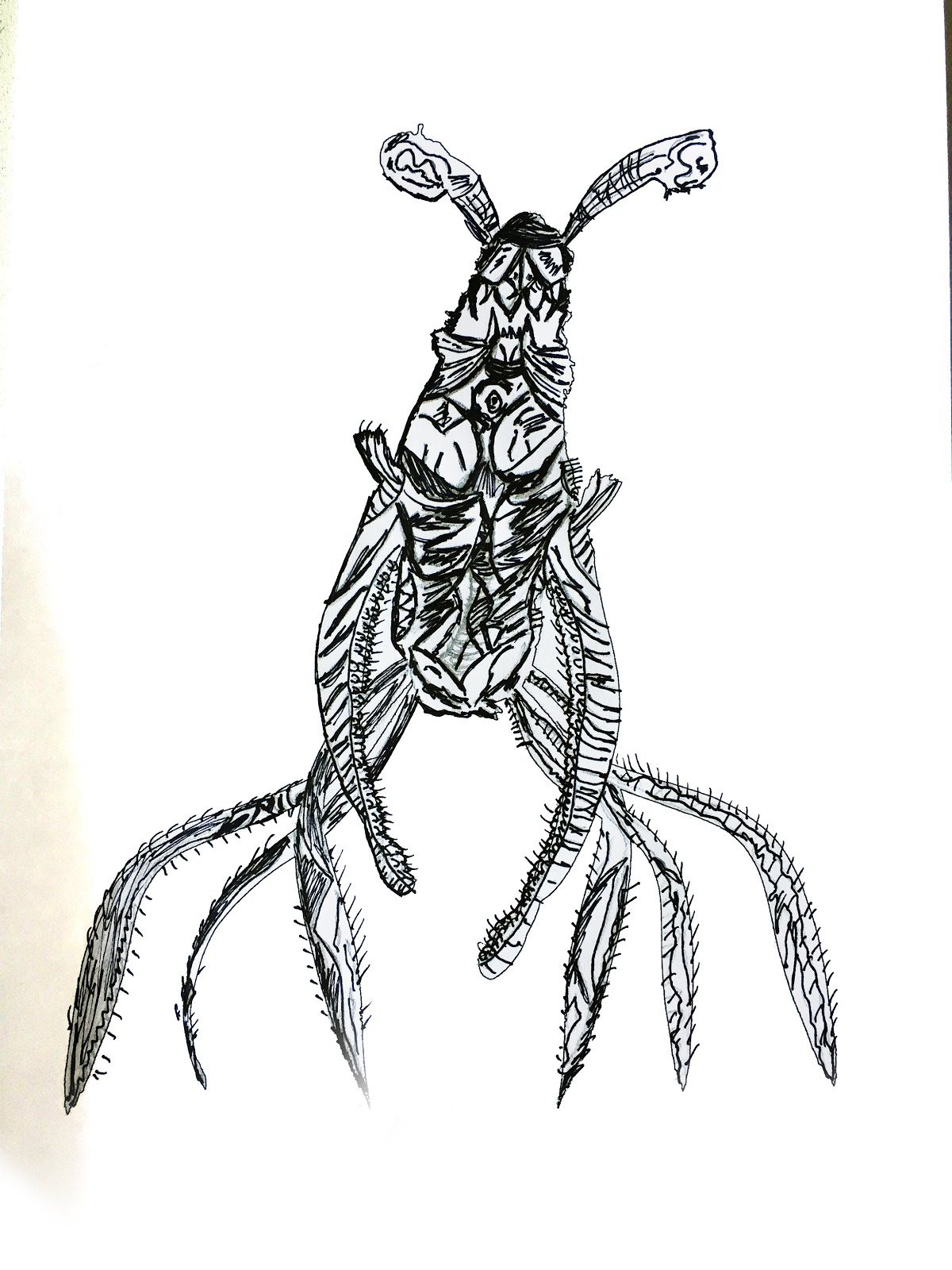


Next up; animation for these silhouettes as well...

Monday, 11 September 2017
Anatomy of a Scene: 'Big Hero Six'; The Police Station scene.
This post is taken from a new lecture looking at the structure of a scene and how the composition and performance tell the story.
The example is Walt Disney Pictures 'Big Hero 6'; directed by Don Hall & Chris Williams.
This scene is a cliche negotiation scene where a child tries to convince an adult authority figure of some threat and fails miserably, only to flee at the threat of 'Hang on while I call your parents'!
To make this scene more interesting and unique the actual negotiation is Hiro trying not to be distracted by Baymax's antics leaking air and repairing himself with sticky tape. In a way Baymax is the child, bored by the conversation and just trying to amuse itself.
This gives the scene far more visual and comedic interest.
Slow track in. Baymax is very passive.
Cut on head move of police man to...
Turns head to establish eye-line for dialogue.
The tape dispenser is in shot, priming the audience for the gag.
Plenty of space around Hiro, head framed by lighter doors behind.
180 rule established with the cop.
Hiro's actions progress towards the lens, making him keen and eager to tell all.
The cop has very limited movement and facial expression. Great finger anticipation during speech. He has seen everything and is not going to be moved.
In contrast Hiro gives a very broad, energetic and highly charged performance.
In this shot the cop is very still, hands not moving, not drawing the audiences eye!. This leaves the frame ready for Baymax's hand to come in and take a piece of sticky tape.
The action of Baymax's hand coming in to take some tape is simple but still managers to display a charming use of curves in the movement. As hand moves out cut-on-move to...
All Baymax's moves are robotic and limited; no shoulder movement. This makes the situation funnier and more surreal.
It is interesting to note comedy always works better if the subject is either front on or at 90 degrees to the camera.
Cutting away to Baymax allowed the camera to cross the 180 line between the two humans.
Repetition of the same gag reinforces it.
Cut back to the cop who pushes the dispenser closer to Baymax.
Because we have cut back this way we have crossed back over the 180 line ready for dialogue to continue.
Hiro is still highly energised and his end pose directs the audiences attention back to Baymax.
Reverse angle; 180 rule observed. Baymax has half of the screen to perform in. He is clear of props and visual distractions to his performance.
All keys have strong silhouettes with great use of negative space.
Less is more! The 'seen everything' cop does not even blink at this.
New angle on Baymax. Eyes blinking out-of-sync.
Cuts on blink to Baymax own view...
Pull focus with hand held feel to shot.
Over the shoulder two-shot. The image of Baymax deflating is reinforced by his eye squashing shut when his head is on Hiro's head.
Cop moves on chair to back table. The chair does NOT move in a straight line, but has a graceful curving track.
This is the moment that the cop says he is going to ring Hiro's parents. Time to go!
Cop turns back, stopping half way to look at clip board and to give time for the duo to leave the room...
Pull out to show tape dispenser, it even moves to screen right slightly...cop looks at it briefly...cut-on-move...
This wide reverse angle shows reveals the now empty reception area as the tape dispenser jumps off of the table and flies to the closed door.
The whole scene is an excellent example of good planning, composition and manipulation of the audiences attention. The acting is strong and the use of strong key frames is great.
The scene even performs well with no audio!!
The example is Walt Disney Pictures 'Big Hero 6'; directed by Don Hall & Chris Williams.
This scene is a cliche negotiation scene where a child tries to convince an adult authority figure of some threat and fails miserably, only to flee at the threat of 'Hang on while I call your parents'!
 |
| Invaders from Mars 1953 |
This gives the scene far more visual and comedic interest.
 |
| Wide Establishing shot |
Slow track in , some traffic goes by. The building is very traditional and old.
 |
| Wide Interior Establishing |
Cut on head move of police man to...
 |
| Medium Shot |
The tape dispenser is in shot, priming the audience for the gag.
 |
| Medium Shot |
180 rule established with the cop.
Hiro's actions progress towards the lens, making him keen and eager to tell all.
 |
| Medium Shot |
 |
| Medium Shots |
 |
| Medium Shot |
 |
| Detail of medium shot |
 |
| Cut-away Medium Shot |
 |
| Medium Shot |
Cutting away to Baymax allowed the camera to cross the 180 line between the two humans.
 |
| Medium Long shot |
 |
| Detail of medium long shot |
Veeeeery slow blink.
 |
| Medium c/u shot |
 |
| Medium shot |
Because we have cut back this way we have crossed back over the 180 line ready for dialogue to continue.
 |
| Medium shots |
 |
| Long shot |
 |
| Long shot |
 |
| Close-up shot |
 |
| Long shot |
Low battery symbol visually reinforces what Baymax is saying.
 |
| Medium shot |
 |
| Close-up |
Cuts on blink to Baymax own view...
 |
| Medium Close-up shot |
 |
| Two shot |
 |
| Medium shot |
This is the moment that the cop says he is going to ring Hiro's parents. Time to go!
 |
| Medium Two shot |
 |
| Medium shot |
 |
| Medium shot |
 |
| Wide Reverse shot |
The narrative continues outside for a couple of shots.
 |
| cut to exterior... |
The scene even performs well with no audio!!
Subscribe to:
Posts (Atom)